Showing posts with label Affect_Me. Show all posts

Saturday, August 15, 2026

The Architecture of Showing Off vs. the Architecture of Shelter

(2 mins read)


There's a rule most of us grew up with: leave your shoes at the door. It felt like manners. Turns out it's something older - a small daily ritual that tells your body: this space is different, this space is protected.

I picked this up while watching a fascinating conversation with Dr. Abdel-Wahed El-Wakil, the Egyptian architect who rebuilt Masjid Quba and Masjid Qiblatain in Medina. He talks about the sacred in architecture - how a home's courtyard was traditionally treated as a sanctuary. Taking your shoes off wasn't hygiene. It was a boundary. You left the street outside, dust and noise and all, and stepped into somewhere calmer.

That idea - architecture as sanctuary, not just shelter - runs through the whole conversation, and it made me think about how differently we build now.

Walk into an old haveli, a Cairo courtyard house, or a traditional Indian home, and you'll notice something: thick walls, small windows facing away from the sun, a central open courtyard, air moving through without a single fan. These weren't decorative choices. They were climate engineering, centuries before the word existed. The courtyard pulled hot air up and out. Thick mud or stone walls held the coolness of the night deep into the afternoon. The building worked with the climate instead of against it.

Compare that to a modern glass tower. Glass looks impressive - sleek, expensive, modern. But glass has one job in a hot climate: it traps heat and passes it straight through. A glass building in Hyderabad in May isn't cooled by design; it's cooled by brute-force air conditioning, running nonstop, burning power to undo what the building itself is doing wrong. El-Wakil makes a sharp point here: glass and steel towers aren't chosen because they function well in our climates. They're chosen because they signal status. We're building monuments to appearance, not shelter.

He goes further, and this is the part that stuck with me: he believes our education systems have quietly taught us an inferiority complex about our own traditions. We're trained to see mud-brick and courtyards as "backward" and glass-and-concrete as "progress" - even when the old methods were smarter for the place they were built in. His own mentor, Hassan Fathy, spent a lifetime proving that mud-brick, built right, beats concrete on comfort, cost, and dignity.

None of this is really nostalgia. It's a question worth sitting with: how much of what we call "modern" is actually just expensive, and how much of what we call "old-fashioned" was just smart engineering wearing a humble material?

Next time you take your shoes off at someone's door, you might notice it's doing more than you thought.

Monday, July 27, 2026

When Dark Clouds Bring Back October 2014

 (3 mins read)


Even now, whenever I see a wall of dark clouds gathering a few kilometres ahead, my mind quietly leaves the present.

For a second, I'm not driving to work or looking out from my apartment balcony anymore. I'm back on a motorcycle, somewhere on the Karnataka coast, staring at the same kind of sky.

October 2014.

It was a five-day bike trip with a few friends and an office colleague. We covered around 1,400 kilometres, weaving through places like Mangalore, Udupi, Murudeshwar, Gokarna and eventually back to Bangalore through Jog Falls.

We weren't chasing tourist checklists.

If a place looked beautiful, we stopped. If it didn't, we kept riding. That was the plan. Or rather, the lack of one.

Somewhere along the way, just before sunset, we noticed it.

A thick line of black clouds sat about 10 or 15 kilometres ahead of us.

One of us looked ahead.

"Ten minutes?" he shouted.

"Maybe twenty," the other replied.

We all did the same calculation without saying much more. The clouds were moving towards us. We were moving towards them. There wasn't going to be a way around it.

Normally, we would've just pulled over and waited.

But it was already getting late, and we had one thing on our minds, we had to reach our destination before midnight.

So we kept riding.

Straight Into the Rain

The rain didn't begin politely.

It arrived all at once.

One moment we could still see the road stretching ahead. The next, it felt as though someone had emptied an entire lake over the highway.

Our raincoats were technically doing their job.

Or at least they were trying.

Against that kind of rain, they didn't stand much of a chance.

The sound of raindrops hammering against the helmet almost drowned out the engine. Water splashed up from every passing vehicle. The visor kept fogging up. Visibility dropped. Traffic slowed to a crawl. Water had started collecting on the road, and before long there was a jam.

Every few minutes, I'd think, "Surely this will ease now."

It didn't.

So we kept riding.

There wasn't anything heroic about it. We were just wet, tired, slightly cold, and focused on the bike in front of us.

After about an hour, the downpour finally relaxed. Not stopped, just relaxed. The heavy sheets became a steady drizzle.

Good enough.

We carried on.

Then hunger arrived.

Not the usual "let's grab dinner" kind of hunger.

Hungry-as-wolves hunger.

The kind where even a biscuit packet starts looking like fine dining.

A little later, through the drizzle, we spotted a roadside dhaba.

I've forgotten its name.

I don't even remember exactly where it was.

But I remember exactly what we ordered.

Maggi.

Bread omelette.

That's it.

We sat there dripping onto plastic chairs, jackets hanging wherever they could, helmets piled in one corner, steam rising from those plates.

I don't know if I've ever enjoyed a meal more.

Not because it was extraordinary.

Because it arrived at exactly the right moment.

Sometimes that's all good food needs.

Today, when I catch myself watching dark clouds gathering in the distance, that evening quietly returns.

It's funny how memory works.

Out of nearly 1,400 kilometres of roads, beaches, hills and towns, it chooses a rainy highway, soaked gloves, and a plate of Maggi to remember.

Maybe that's because comfort has a way of feeling much richer after you've spent some time without it.

Wednesday, May 27, 2026

Seven Years Old and Certified: The Quiet Death of the Kite

(6 mins read)


How a government protected a beloved tradition — by quietly making sure nobody could practice it anymore.


The notice arrived on a Tuesday. It was not a ban. The government was very clear about that.

It was a Kite Welfare and Safety Regulation Framework. Four pages. The word "ban" appeared exactly zero times. What appeared instead were phrases like age-verified aerodynamic certification and phased compliant. The Ministry of Kite Welfare wanted everyone to know: this was a protective measure for the kites.

The kites, apparently, had been suffering.

Rule One: Only kites aged seven years or older may be flown

A kite is made of paper and bamboo. It is not wine. It does not improve with age. Leave a kite in a shed for seven years and what you get is not a vintage kite - it's torn paper and bent sticks that will fly for about four seconds before quietly falling apart over a neighbour's roof.

The kite sellers of the old city: families who had run the same small shops for three or four generations read the notice twice. Then a third time. Then they looked at each other.

"Seven years?" said one.

"Seven years," said the other.

There was a long silence. That silence said everything.

Rule Two: Every kite needs a certificate. Getting one is nearly impossible.

To fly a kite legally, you now needed a Certified Airworthiness Certificate. Fair enough: except that there were only three certified Kite Welfare Officers in the entire state. One was in the capital. One was on medical leave. The third had retired, and nobody had replaced him.

To get your kites certified, you had to travel to the capital, pay a certification fee equal to roughly 40% of your monthly income, wait fourteen weeks for an appointment, and arrange your own travel and stay.


The Official Rules at a Glance


Rameez sold kites from a cart near the railway station. He supported his mother and two younger sisters on that income. He did the math. The certification trip alone would cost him more than he made in two months. The wait was fourteen weeks. The fines for flying without a certificate were fatal.

So Rameez stopped selling kites. Not because anyone told him to. Because the alternative was financial ruin dressed up in paperwork.

Rule Three: The string is also illegal. Sort of.

Kite string now had to come from a "certified domestic manufacturer." Imported string was banned - to protect the local industry, the government said. A nice idea, except there was not a single certified domestic string manufacturer. The certification process for them was still being written. Timeline: under review.

So the string that kite fliers had used for decades - the same string their parents used, wound into spools and sold from the hooks of a thousand small shops - became, without anyone saying so directly, illegal to use. The Ministry called it "non-compliant material." The fines for using it were enormous and very real.

The string sellers quietly shut down. Some switched to selling rope. The older ones just sat in front of their closed shops and didn't say much.

The one place you could legally fly a kite

There was one open Kite Recreation Zone. It was 43 kilometres from the city. Accessible by one bus — which ran on alternate Tuesdays - and then an auto-rickshaw that charged whatever it felt like. The Zone itself was a small rectangle of government land surrounded by a chain-link fence. There was a sign. There was also a padlock on the gate, and nobody in the local government knew where the key was. The matter, they said, was being looked into.

The children of the city, who had grown up running on rooftops with string cutting into their fingers and their eyes on a sky full of color, slowly stopped doing that. There was nowhere left to go.

Who actually got hurt

The obvious answer is kite sellers. But the kite economy was a small, quiet world with many people in it.

There were bamboo cutters in three villages who supplied the thin strips for kite frames. Demand disappeared in one season. There were the paper makers - the ones who made the particular thin paper that no other trade really used. The string winders. The cart pullers who moved stock to festivals. The tea stall owners near the flying grounds who sold chai to people waiting for a good wind. None of these people had done anything wrong. They had simply been part of something ordinary, and now ordinary had become a compliance problem.

It was not, technically, a ban. It was simply that doing the thing had become indistinguishable from not doing the thing - except the fines were very real.


The twist nobody talked about


About eighteen months after the regulations came into effect, a group of large, well-funded companies quietly applied for - and received - National Kite Production Licenses. They were the first to successfully navigate the certification process. The Ministry announced this as proof that the system was working.

These companies did not sell kites in the country. The domestic market was, in the words of their investor documents, "operationally constrained." Instead, they exported. Within two years, the country's kites - made in factories, certified in bulk - were being sold at a large markup in European gift shops and artisan markets. The marketing called them authentic, handmade cultural artefacts.

In the old city lanes where kite sellers used to be, there were now other shops.

What the government kept saying

The government had not banned kites. This was technically true. You could fly a kite - as long as it was seven years old, had a valid certificate, used approved string, and was flown in a licensed zone. Completely legal. Completely available. Completely impossible.

And the government was proud of the country's growing kite export market. A sign of culture reaching the world. A sign of tradition becoming industry. Whether the people who built that tradition - on rooftops, with cheap string and paper thin enough to see sunlight through - had any place in this success story was a question nobody in a glass building seemed to be asking.

The old man on the terrace

The last time I saw someone fly a kite in the city, was at dusk. An older man on a terrace three buildings down. A worn kurta. A kite that was definitely not certified. String that was definitely not compliant. A rooftop that was definitely not a licensed zone.

He flew it with the calm ease of someone who had done this for fifty years and found the paperwork argument unpersuasive.

A child next door watched him with the kind of attention children give to things they sense are disappearing.

Somewhere below, in an air-conditioned office, someone was probably drafting the next amendment. The fines were being doubled. The certification process was being "streamlined." There was talk of an app.

The kite caught the last light and held it. The old man laughed at a sudden gust, made a small adjustment with his wrist - the kind you can only learn over decades, the kind no certificate can measure, and the kite steadied, and climbed.

It is not banned. The sky is completely free.
___________________________________________________________________________

This is a work of allegory. Any resemblance to actual regulations, closed supply chains, or mysteriously padlocked recreation zones is a coincidence the author is too tired to argue about.


Friday, March 13, 2026

Moon Sighting, Not Moon Fighting: How Muslims Balance Tradition and Technology

(4 mins read)

image generated by using a feature in ChatGPT


Every year, around the beginning of Ramadan or Eid, the same question returns.

“Why are Muslims still looking for the moon?”

In an age of satellites, telescopes, and advanced astronomical software, the idea of physically sighting the moon might seem puzzling, even primitive, to some observers.

But the story is more nuanced.

Moon sighting in Islam is not simply an astronomical question. It sits at the intersection of astronomy, jurisprudence, tradition, and spirituality.

To understand it properly, we need to step back and examine the principles behind it.

1. The Lunar Calendar: A system anchored in nature

Islam follows a pure lunar calendar.

Each month begins with the appearance of the new crescent moon (hilal). A lunar month lasts either 29 or 30 days, depending on when the crescent becomes visible.

The Prophet Muhammad ï·º explained this clearly:

“Fast when you see it (the new moon) and break your fast when you see it, and if the sky is cloudy for you, then complete thirty days.”

This simple instruction forms the foundation of Islamic timekeeping.

If the moon is sighted → the new month begins.
If it is not visible → the previous month completes 30 days.

There is no ambiguity in the rule.

2. Islamic law is built on observable reality

Islamic rulings often rely on clear, observable signs rather than complex calculations.

The Prophet ï·º even described the early Muslim community in a striking way:

"We are an illiterate nation; we neither write, nor know accounts. The month is like this and this, i.e. sometimes of 29 days and sometimes of thirty days."

This statement was not a rejection of knowledge or science. Rather, it established an important legal principle:

Religious obligations should remain accessible to everyone.

A farmer in a desert, a traveler on a caravan route, or a modern scientist, all can determine the start of the month in the same way: by observing the sky.

3. Why astronomical calculations alone are not the basis

Modern astronomy can estimate the timing of the new moon using complex calculations and models. However, these predictions are ultimately probabilistic in nature. Because Islamic rulings are tied to observable signs, the start of the month is linked to the actual sighting of the crescent rather than relying solely on calculated projections.

These are two different things.

The new moon occurs when the moon aligns between Earth and the Sun. At that moment, the moon is actually invisible from Earth.

The crescent appears later, sometimes 15–24 hours after the new moon, depending on:

  • latitude
  • horizon conditions
  • moon altitude
  • atmospheric clarity
  • local geography

Because of these variables, the moon may be visible in one region but not another.

This explains why moon sightings can legitimately differ across locations.

Just as people pray Fajr at different times across the world due to sunrise variations, lunar visibility also varies geographically.

4. Differences in sighting do not mean division

Observers sometimes interpret different Ramadan start dates as a sign that the Muslim community is divided.

In reality, Islamic jurisprudence has long recognized local moon sightings.

Classical scholars discussed whether a sighting in one land applies to another. Some jurists accepted global sightings, while others held that each region follows its own observation.

A narration from early Islamic history illustrates this. When a companion reported that the moon had been seen in Syria, the scholar Ibn Abbas in Madinah replied that they would continue fasting until their own sighting or completion of thirty days, following the instruction of the Prophet ï·º.

This shows that regional differences were known and accepted even in the earliest generations.

5. Authority and community consensus

Islamic practice also emphasizes communal order.

Moon sightings are typically verified by:

  • reliable witnesses
  • official moon sighting committees
  • recognized religious authorities

Once the announcement is made by the community leadership or majority, the matter is considered settled.

Islamic scholars emphasize that individuals should follow the decision of their local community to maintain unity and avoid unnecessary disputes.

In other words:

The goal is not for every individual to independently verify the moon.

The goal is collective clarity.

6. Moon sighting as an act of worship

There is also a subtle spiritual dimension.

Sighting the crescent is not merely administrative; it is a moment of devotion.

Generations of Muslims have stepped outside after sunset, scanning the western horizon for the thin arc of light that signals the beginning of a sacred month.

There are even supplications traditionally recited when the new moon appears.

7. The role of astronomy today

Astronomy still plays an important role.

Calculations help determine:

  • when the moon cannot possibly be seen
  • when sighting is likely
  • where visibility may occur

In this sense, calculations act as a guide or probability indicator.

But the final confirmation traditionally remains actual sighting.

Calculation informs! Observation confirms!

8. The simplicity of the system

Perhaps the most elegant feature of the Islamic lunar calendar is its simplicity.

There are only two possible outcomes:

  • 29 days if the moon is seen

  • 30 days if it is not

No leap years.
No complex adjustments.

Just the sky.

This simplicity was intentional. Islam repeatedly emphasizes removing unnecessary hardship in religious practice, and the lunar calendar reflects that philosophy.

Final Reflection

From the outside, moon sighting may appear outdated.

But when viewed within its proper context, it reveals something deeper.

It is a system designed to be:

  • universal
  • accessible
  • observable
  • spiritually meaningful

It anchors sacred time not in bureaucratic systems but in the natural order of the heavens.

Every month begins the same way it did fourteen centuries ago:

A few people look toward the western horizon.

And if the crescent appears, a new chapter of time quietly begins.


Resource

Saturday, April 26, 2025

Degree, Job, Done?

(3 mins read)

pioneers of Science in the 20th century

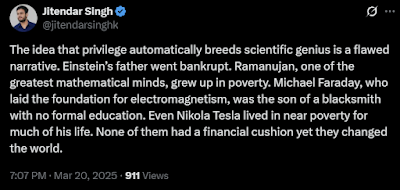
A few days ago, I came across a tweet and some replies to it that really made me think. They spoke about privilege, adversity, and how our circumstances shape the path we take, especially when it comes to higher education and innovation in science.

Author's tweet

Support for the author's tweet

Counterpoint to the author's tweet


It made me pause and reflect.
Why didn’t I pursue higher studies?
Was it a lack of ambition, or something else?
What role did my background, my parents, and my responsibilities play?


Growing up, I didn’t have the luxury to dream big. My father worked tirelessly, barely making ends meet. My mother gave tuitions and taught in a primary school, not out of passion but necessity. There are many like me who belong to the lower middle class in India, where engineering isn’t seen as an ambition, but as a gateway to a stable job and a way to start supporting the family. I am the eldest in my family, so when I graduated with a degree in Information Technology, there was no question of further studies. The family needed support, and I had to step in. That job meant survival, more than success. If I had chosen higher studies, it would’ve meant more sacrifices, and perhaps, an increase to the family’s burden, both financially and emotionally. So I shelved my ambitions: not out of regret, but out of responsibility.

But dreams are strange things: they don’t die, they just change form. I don’t want my children to carry that weight. I want to be the cushion I never had, give my children what I never had: the luxury to choose learning over earning. Job and income shouldn't be their finish line. 

They should have the freedom to take risks, to explore astrophysics, quantum computing, study the stars, or fail at a startup. 

Like a runway for a plane, long enough to gain momentum before flight. Not too short for the plane crash, and not too long, for the plane to never take off.
Like training wheels on a bicycle, offering balance until they can ride on their own. 
Or a safety net under a trapeze artist, not to prevent falls, but to allow daring leaps. 

The wealth that I provide for them cannot just be money; it should also include freedom. And if my hard work and sacrifices mean they get to chase knowledge and focus on learning instead of just earning, then I’ve done my part for humanity.


Saturday, August 28, 2021

Why I do not read all my messages and why you shouldn't too


Look, I acknowledge this is not a very popular opinion. I feel guilty when I do not respond as quickly as the concerned person would have wanted. I also admit that I feel insulted when someone doesn't text me back right away.

WhatsApp chat notification
My WhatsApp unread chat count


As you can see from the screenshot above, I have too many unread messages. Yes, I know it is 'too many'. Some may feel it's too messy or I am too unorganized.  But before you judge me further, let me clarify few things:

  1. I am part of many WhatsApp groups where both way interaction is not required; groups where information related to jobs are posted. I can share any information about job vacancies (if I have) and choose to ignore the rest of the message (since I am not the recipient)
  2. Most of the unread chats ended with "okay", "fine", "Thank you" and other such concluding remarks. I choose to not open the chat to read them. Those are anyway seen from notification panel
  3. I could be at work. I choose not to get interrupted while I am at work. Text messages are a high value interruption, especially if we respond to each other right away
  4. There are many family groups, uncles and aunts who keeps wishing everyone Good morning and good night. I can choose to ignore those kind of messages without any repercussion
  5. Too many festive greetings. Some friends and groups are there only to wish festivities. I look away from those (well most of them, not all)
  6. I may not be in the mood. I could be a bit cross with certain things in my life and I may not be in that situation to respond emotionally
  7. One very important reason of not responding it soon enough is that phones and messages were made for me, and not the other way round. I don't want to be slave to a mobile device. When I find time I read text message. It could be on weekends, or later in the day

It's not like I am too busy. I am very much active in the chats where my attention is required. But the good thing is that I can choose the time and duration of this wonderful technology. The technology does influence us how we think, but let it not drive us crazy. I do respond to each text, wherever required. 

In no way I am defending certain people who:

  • Is too lazy to respond
  • Reads the message and ignores and never replies back because they 'forgot'


See, it's your life and you only get to live it once. Live it to its fullest. And it’s too short to worry about people being mad that you don’t reply to their text right away
.


Monday, May 10, 2021

Here’s how we are trying to help during the COVID-19 pandemic


Our country is navigating through a worst kind of pandemic. The current situation is not unknown to us. While few run around the city to get a life support for shortness of breath, few others are on phone searching through their contacts to get beds and oxygen for their dear ones.

A few days ago, couple of us were on phone to find a bed for a relative whose oxygen saturation was way below a normal range. We tried calling any and many hospitals in Kolkata – called for more than 5 hours without getting any positive response. Most of the time the numbers shared on social media were un-reachable. The difficulty was clearly visible, it wasn’t a horror story from children books anymore. We could imagine the pain faced by so many people across the city and country as a whole.

A group of friends got together and decided we would go through all the contacts that are circulating in the social media, and call them one by one and see which one are genuine. We would only keep them and circulate those among the needy ones. And hence this idea gave birth to https://cov-aid.github.io/resource/ - a portal where contacts for oxygen, beds, hospitals and vaccines are updated real time (by a bunch of volunteers). We call the source every day and update the information based on their response.

This portal provides information for Kolkata only as of now. For pan India, this site should be useful https://indiacovidresources.in/ (Please do note that most information available on the website is vetted by third parties. So you might have to do some due diligence before transacting with these suppliers)

We hope our sincere efforts are of use to the families in need and we also pray that our efforts are rewarded hereafter.

If you want to contribute as a volunteer, then please fill up this form – Google Form


Saturday, May 9, 2020

Learnings from Coronavirus outbreak

Sitting on my swing chair I was wondering how many days have passed since the lockdown. I started to calculate and it was 46 days ago when my country, India decided to go under complete lockdown. I am under self-isolation a week earlier to that. Unless you are living under a rock, I hope you are able to understand what I am speaking about here. Yes, it is the coronavirus pandemic that has brought a halt to many of our lives and changed our lives completely, giving several degrees of turn to it.

I was still on my swing chair and my train of thoughts were on a ride, pondering on many questions. Questions like – ‘when will this end?’, ‘will our lives be different then?’ and ‘what learnings do we take from this part of our life to the other part?’ Among such questions, one rose above the other. It seemed to me that in my tracks of thoughts there was this question taller than others and raising its hand high up in the air, higher than the others. I had to but notice it. It asked – ‘Did isolation benefit anyone?’ Well, to be honest I have had read about people like Martin Luther King Jr., Nelson Mandela and Ibn Taymiyyah (ra) writing while they were in prison. Our current situation is not exactly like prison, but we are confined to the 4 walls of our homes, stepping out unless completely necessary is prohibited, we have to maintain physical distances with one another – hence there are similarities. So, I thought to myself, “Why don’t I write. That will be my contribution during this lockdown.”

At the time of this writing, there have been more than 4 million people affected by coronavirus and more than 270K deaths from the COVID-19 pandemic worldwide. In India alone number of people with positive CVIOD19 disease has crossed 60K. In three short months, a novel coronavirus has captured global consciousness and changed day-to-day life in large parts of the world, in the process becoming a public health emergency. This is like no event before – not in our lifetime, neither in our father’s our grandfather’s life time. While we are coordinating with the local, national, and global response to the rapidly changing situation, we are, collectively, learning how to better tackle with this pandemic.

While there will be much to learn when (we hope) this pandemic is over, I think there are some key lessons that I have learnt that are worth highlighting while it has dominated all our conversations and sharpening our thinking.

Lesson one: Humility and gratefulness– When this crisis ends I hope and pray that we all will be humble and have a sense of gratitude. We take lot of things for granted but in reality it is not. Our jobs/business, family, the air we breathe, water we drink, food we eat, services we receive, etc. are nothing but blessings from our Almighty Allah swt. Current lockdown has made us understand that there are many who are not so privileged. We should be and act grateful

Lesson two: Going Digital - It is part of how every industry will be transformed as the pandemic hastens the digitalization of work in every sector. All those jokes on work from home that were there in the beginning of the crisis – well they are gone now, because these are new normal. We have learnt to accept the situation and have educated ourselves to work remotely. I understand not everyone in the population are blessed to do that. But necessary is the mother of the invention. People are providing services online, teachers are teaching online, doctors are prescribing online, and so on

Lesson three: Our health - We are not doing enough for our health both at individual level and at government level. This crisis has exposed lot of holes in our rather dilapidated health system. What we understand now is that the digital future cannot simply make the wealthy healthier.
Nonetheless, doctors and nurses are symbol of angel in this horror time. Our health care workers are amazing and we owe them a huge debt. Same for grocery store employees, deliverymen and women, and the many other essential workers who keep us going

Lesson four: Science matters - Denial of climate change and the safety of vaccines are examples of how science can be pushed aside when it conflicts with a political agenda. Yet science matters. This is especially clear during this specific coronavirus disease outbreak. We are eagerly waking up every day with our hopeful eyes that someone from some part of the world will announce the best news of our history that COIVD19 vaccine has been created

Lesson five: Education of the public matters - Remaining clean is a must. Who knew? Well, now we all do, and we’ll probably wash our hands a lot more frequently after this is “over.” Preventing disease in populations takes robust, responsive health systems, cities and communal spaces that are built with health in mind, economies that do not generate the poverty and income instability that feed poor health, and cooperation at the local, national, and global level in creating the conditions for health. All of this requires long-term planning, and a willingness to invest in health as a public good worthy of collective by-in. This begins with educating the public about what really matters for health. The reaction to Covid-19 has shown how much we still must do in this regard

We do not know till when we will have live with this new normal. Once this ends life won’t be the same after—and that’s okay. The coronavirus pandemic is a horrible examination, but are there some things positive that may come out of all this hardship? God willing we will conquer this virus too but I hope that doesn't take away the humility from us rather make us more humble. I hope we are better educated about our health by then and learnt to live with hope and gratefulness towards all the blessings we have.


Monday, September 23, 2019

India in 2030 - my thoughts

When man discovered fire, it was the start of the long term impact in the progress of mankind. By controlling fire, man’s way of living the life evolved – he started to cook food, stay safe and in many ways discovered cure for his illness. Life before and after fire have stark differences. With that one slight deviation, man has come a long way. Let’s ask a similar question about our country – Has India discovered its own fire? Some may say yes – it was in 1947 when it acquired independence from the clutches of British Empire. Some may argue – it was during the turn of new millennium that India’s thought towards the advancement and development took a new direction. 

Every individual would have their own understanding of what that ‘fire’ is. The former president of our country Dr. A.P.J. Abdul Kalam wrote a book “India 2020: A Vision for the New Millennium” where he offered a blueprint for India to be counted among the top 5 economic powers of the world. To him economic and prosperity in each of the market sector is the area where India should look to develop itself. While India may be on the way to become a global super-power economically (India is currently 6th in economy global rank and it is set to enter top 5 by toppling UK in couple of years with the combination of Brexit and better economy growth rate of India), it is hard not disagree that there is still some way to cover to call ourselves developed. 

Few may dispute that yes economic development is an important factor for growth but improvement in health and safety is more essential, while others may claim that food, shelter and law & order are of utmost significance. Similarly we will find every economist, every individual or group who takes pride in supporting sustainable growth are likely to opine on his or her idea of India 2030. 
We have around 11 years to reach 2030. However, what we desire to be our future state will not achieved if we do not work towards that now. There is never a wrong time to do the right thing. I really want to start now but where do I want to move towards? What journey do I ask my fellow countrymen to take? I was trying to think and get an answer to those questions when it struck me. I was overwhelmed by a happy memory. I recalled an incident which is very close to my heart – I was in class 10, we had recently taken our board exams. Our school management and juniors invited us for a farewell party. Emotions were flowing while we bid goodbye to our teachers and juniors. We were requesting our teachers for autographs and messages on our farewell card. One of my favorite teacher (incidentally happened to give Math classes as well) wrote just 2 words – ‘Be Happy’. My teenage hormones wanted him to write more than just 2 words. But he explained – “Tanzeel - this is a very good prayer, when you grow up you will understand”. Yes, I now understand what amazing and significant message that was. I now feel being happy is what everyone want. It is the combination of all other adjectives. The desires of men end there. It is just not the goal of 2030 but today, tomorrow and the day after. It is just not about me but also about you and also about my whole country. Yes, I want my country to be happy. And, no it is not happy today. 

I want my country to be happy!

I want every inhabitant of my country to be happy, feel the freshness of being happy and spread it to others. My country ranks 140th among the 156 countries surveyed by UN in the World Happiness Report. It’s not that there is no choice. There is always a choice about how we lead our life. We should start by having right set of attitude. We should be open to everyone who impact our lives directly or indirectly. Conversation is the key to happiness. We have somewhat created an invisible barrier in front of us. This barrier or shield is either because of religion, political difference or status quo. Dialogues with people will break this barrier. Let’s start dialogues and have discussions with people. Let’s acknowledge to what people have say to us. It is not very difficult in this age, a simple movement of few fingers and lo the chat message is sent. Let’s behave as a part of one big family (in reality we are – born from the same set of parents).
Conversations will play a fundamental role in striding towards happiness. It will start engaging people, work will be done faster, and returns will be seen in quicker duration. A complete task will create positive energy which in turn will bring happiness. A happy person is infectious. He can easily transfer that attribute to others.

A small step in being happy and making others happy can have a snowball effect in country’s growth and prosperity. In my happy India in 2030 I would want to see people having no grudges with each other. The happy set of citizen will be able to take care of health, safety, law & order issues. They are also able to make sustainable development and advance towards huge economic growth and prosperity. They are ready to accept their differences and yet engage with each other – as we all do in one big and happy family. That happy India will be devoid of any rape cases and no honor killing – there is no honor in that. My happy India will have more happy cities that will be less chaotic as population will be distributed as oppose to concentrated to few cities of today. In my future happy India, mob lynching will be a thing of past, security problems in Kashmir and Northeast are solved. The mind should be without fear and ease of sharing one’s voice is of the highest value. My India of 2030 should have minds which makes leaps and bounds towards technological advancement, make sustainable growth, all of these without compromising on the value of happiness.

So for me, ‘Being Happy’ is the fire we need.

Saturday, May 18, 2019

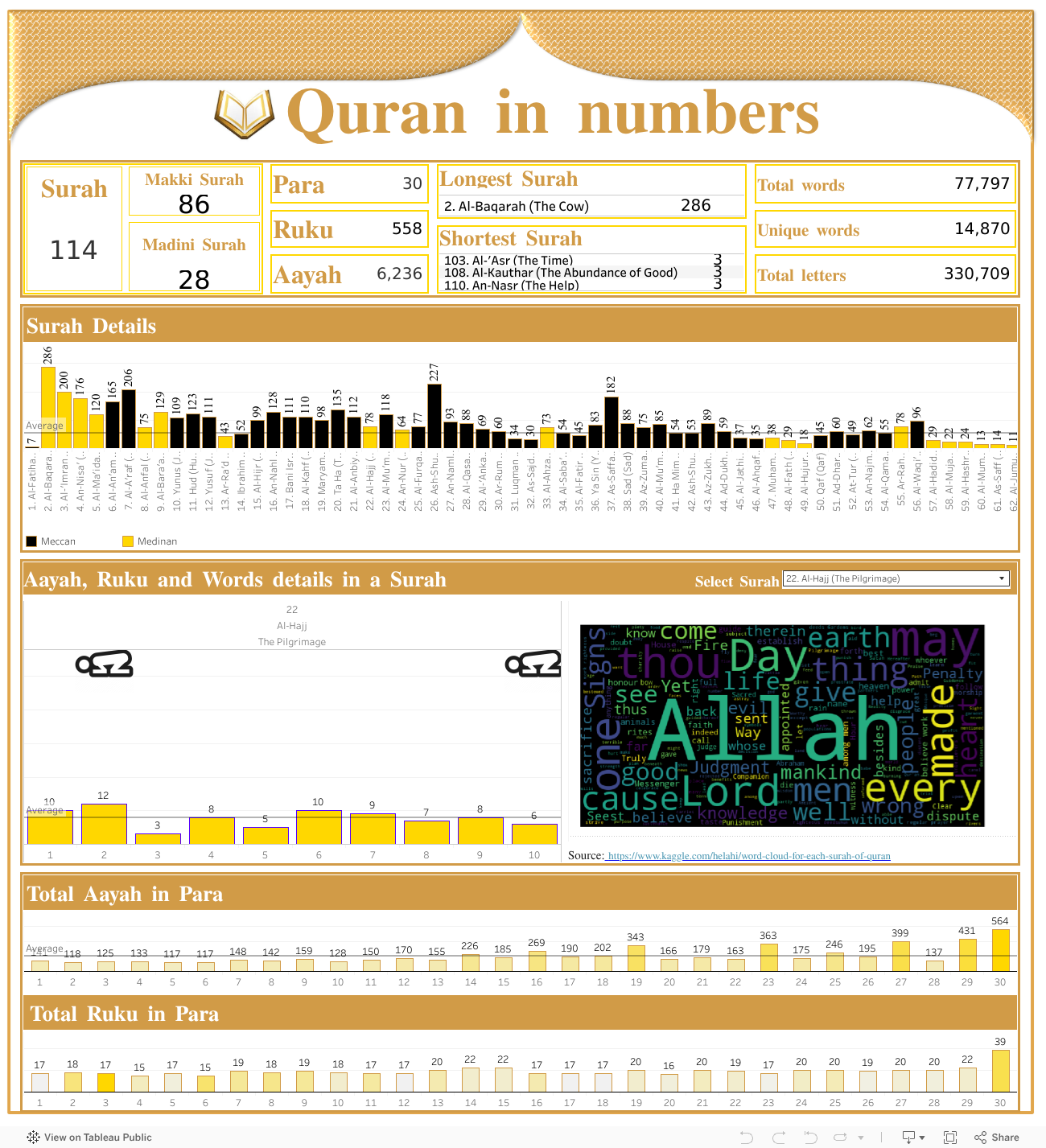
The Holy Quran in numbers

I have always been fascinated by numbers. My job as an analyst verifies that. Growing up as a Muslim child, we have been taught to read the Holy Quran in Arabic. Although we do not understand it completely but we are quite fluent in reading it. The Holy Quran is one voluminous book consisting of more than 600 pages and 114 chapters (also called as Surah). I was intrigued by the way it had been layout - the lines, the verses (also called Aayah), the chapters seemed so random and unequal. Its structure does not resemble any traditional or academic book that we read. However that understanding from my childhood days was debugged later. A few years ago when I started to study Quran in depth and understand the sciences of Quran – I began to realize that there is indeed wisdom behind the structure and layout of Holy Quran. For starters – The Holy Quran is kalamullah meaning it is a word of Allah ï·», such that it is been spoken to the Prophet Muhammad ï·º. The arrangements of the chapters (Surah) and in it the placement of all the verses (Aayah) are all been designed and told to Prophet Muhammad ï·º by Allah ï·». The students of Quran finds the Holy Quran to be divinely arranged.
According to Late Dr. Israr Ahmed saab there are various pearls of wisdom the student of Quran can extract while studying it. They are as follows:
  •        Revolution (and motivation)
  •        Coherence (the structures of Surah and Aayah and how they are related to each other)
  •        Legals and philosophy
  •        Sufism (and its esoteric elements)

Dr. Israar Ahmed saab once said that the great scholars of Quran even though having spent their years and lives in understanding the Holy Book, have only extracted the wisdom from one of its angle. Hence it is important for any student of Quran to delve oneself into the research of various scholars exploring different perspective and picking up of that wisdom.
Having said that, I took a stride to understand the numbers in Quran. I started with counting the numbers of aayah and ruku present in each Surah and tried to visualize that in Tableau (a business intelligence tool). The Tableau tool have been embedded in this post. However, due to its size, it is not completely visible. Hence you could do either of the following to see the full view:
  •        Scroll to the right bottom and you will see full screen option. Click on that
  •        Click on the following link and this will take you to the Tableau Public page and there you could see the full visualization

The visualization looks better when viewed in laptop/desktop as there you could view the tooltip on hovering over the numbers. Through the tooltip, I have tried to brief on the definition of surah, aayah and ruku. For the word cloud there’s a dropdown provided using which a user can filter for the Surah of their choice and can see the number of ruku and aayah in each Surah and the words mentioned in the Surah (highest number of occurrence of words in Surah have larger size).

Explore different sections and let me know if I could provide/explain anything more.